Heat Staking Thermal Press: What It Is and When to Buy One
By Alex Spurgeon — 2026-06-16
A heat staking thermal press melts a small plastic post into a head that locks your parts together. No screws, no glue, no cure time — permanent commitment on the first date. It's the workhorse most assembly jobs actually want, and the machine buyers most often overspend around. So before you sign for any shiny iron, let's sort out whether a thermal press is your machine, and what a good one has to do.
> TL;DR — A heat staking thermal press uses a heated tool to soften a plastic boss, form it into a head, then cool it under pressure so it sets clean. It's the right buy for most jobs — dissimilar materials, metal-to-plastic, glass-filled, cosmetic parts — and costs less to own and run than ultrasonic. Reach for ultrasonic only when raw cycle time is your bottleneck at real volume. Spec it to your part with a free evaluation, and we quote within 24 hours.
Who actually needs a thermal press
If you're joining plastic to plastic, or metal to plastic, in any kind of volume, and you'd rather not babysit screws backing out under vibration, a thermal press is probably your answer. It's the most flexible machine in the staking world.
Here's the honest version of the pitch: most parts do not need anything fancier. Thermal press staking joins dissimilar materials, it's gentle enough for glass-filled and high-temperature plastics because there's no high-frequency vibration to micro-crack them, and the equipment is generally lower cost and easier to keep running than ultrasonic. If a vendor is steering you toward the priciest process before they've seen your boss geometry, they're selling iron, not solving your problem.
If you're still deciding whether to stake at all versus screw or snap together, the wider machine buyer's guide covers that fork. This post assumes you've landed on thermal and want to buy the right one.
Thermal vs ultrasonic vs hot-air, for buyers
For most jobs a thermal press wins on cost and material range; ultrasonic only wins on raw speed at high volume; hot-air earns its keep on cosmetic surfaces. Three machines can form a plastic head, they are not interchangeable, and the cheapest sticker price is rarely the cheapest part. Here's the buyer's view at a glance:
| | Thermal / impulse press | Ultrasonic | Hot-air / cold-form | |---|---|---|---| | Material range | Wide — dissimilar materials, glass-filled, high-temp | Narrower — sensitive to material and boss design | Cosmetic A-surfaces, multi-boss shots | | Cycle speed | Fast; not the absolute fastest at very high volume | Fastest — sub-second per stake | Slower | | Relative cost | Lower to own and run | Higher price tag | Higher tooling/airflow setup | | Maintenance / setup | Low maintenance | Fussier setup | Needs more airflow and tooling to dial in | | Best for | Most jobs — the default buy | High-volume lines where cycle time is the bottleneck | Cosmetic parts and no-witness-mark finishes |
Thermal / impulse press is the default for a reason. Wide material range, clean heads when you cool under pressure, low maintenance. It's not the absolute fastest at very high volume, and that's the only real knock.
Ultrasonic is genuinely quick — sub-second per stake, and Assembly Magazine confirms ultrasonic staking cycle time can be under one second — so it earns its keep when cycle time is the bottleneck on a high-volume line. The trade-off is a higher price tag, fussier setup, and more sensitivity to material and boss design. It is a speed play, not a default. (Anyone who tells you it's always the answer is, I promise, paid by the hour the machine is in their catalog.)
Hot-air / cold-form never touches the molten plastic, so it leaves no witness marks and shines on cosmetic A-surfaces and multi-boss shots. It's slower and needs more airflow and tooling to dial in. For a deeper head-to-head on the big rivalry, see heat staking vs ultrasonic.
What one impulse cycle does
The word "impulse" is doing real work here. A good thermal press doesn't just hold a hot iron on the boss and hope. It runs a tight sequence: deliver heat, form the head, cool it under pressure, then retract clean.
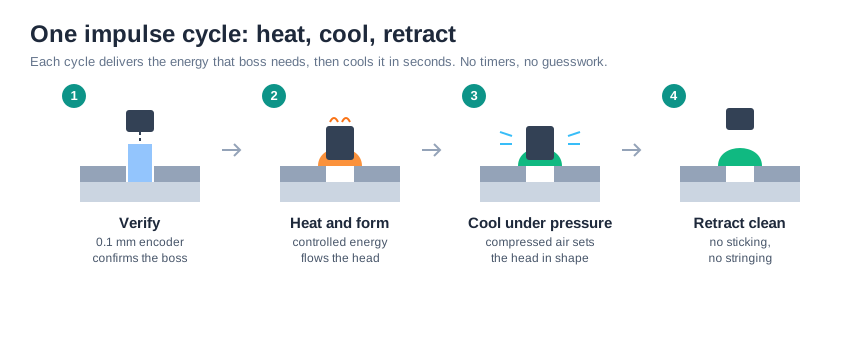
Verify, heat, cool, retract. The cooling step under pressure is the one people skip, and the one that prevents cracks.
That cooling step is the whole ballgame. The tip is cooled with compressed air so the plastic solidifies in seconds, holding the shape you just formed instead of relaxing back or sticking to the tool on the way up. Skip it to shave a second and you trade it back later in cracked boss bases and field failures. A press that does this properly gives you clean heads with no stringing on retract, cycle after cycle.
A timer and a hot tip is not a precision press
Here's the opinion I'll plant my flag on: a timer and a hot tip is not a precision machine, no matter what the brochure calls it. If a press forms the head by holding a set temperature for a set number of seconds, it's guessing. Boss height varies. Ambient temperature drifts. Material lots shift. A fixed timer can't see any of that, so it over-forms some bosses and under-forms others, and you find out at the pull test — or worse, in the field. (Boss geometry is what makes or breaks the joint in the first place — our heat staking design guide covers boss sizing and head ratios.)
What actual control looks like: our patent-pending "Weld by Energy" system uses one setting for power delivery, and each cycle delivers the precise energy that boss needs to weld — no timers, no stopwatch, no recipe roulette. A 0.1 mm linear encoder confirms the boss is even present before the cycle runs and that the head finishes within tolerance. That's the difference between a machine that controls the outcome and a hot stick on a timer that hopes for it. My apprentice Jake called the old timer rigs "confidently wrong," which is the most accurate spec sheet I've ever heard.
It works across ABS, polycarbonate, nylon, polypropylene and the other usual thermoplastics, and it mechanically secures metal into plastic too. You can see the press itself on the Benchtop Press page, or the full heat staking equipment lineup.
How to spec the right configuration
Once you're buying thermal, the next question isn't "which is the best machine" — it's "which configuration fits how you run." There are two honest answers.
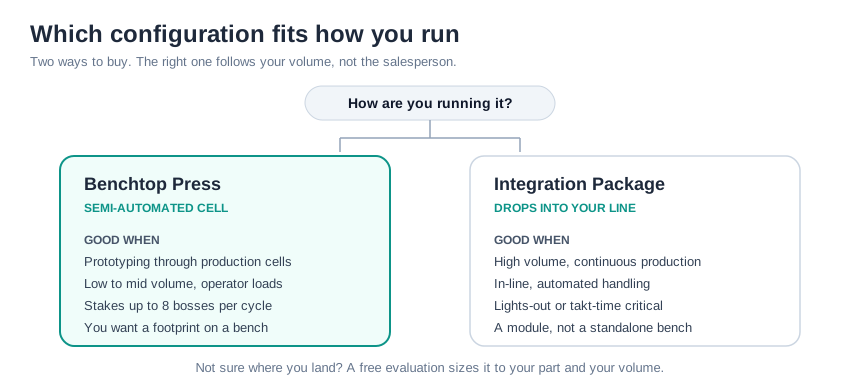
Two ways to buy. The right one follows your volume, not the salesperson.
| | Benchtop Press (Model BTP) | Integration Package | |---|---|---| | Volume | Prototyping through low-to-mid production | High-volume, continuous, or lights-out | | Automation level | Semi-automated cell, operator loads parts | Module that drops into an automated line | | Bosses per cycle | Up to 8 in one cycle | Same controlled process, configured to the line |
A Benchtop Press is the semi-automated cell: prototyping through production runs, an operator loading parts, and up to 8 bosses staked in a single cycle. It earns its spot on a bench in low-to-mid volume.
An Integration Package is a module that drops into an automated line for high-volume, continuous, or lights-out production. Same controlled process, no standalone bench.
When you spec either one, get the fixture, the tooling, and the validation in writing before you commit. A quote that's only the machine is half a quote — somebody still has to pay for the part fixture and somebody has to pull-test and cross-section a sample to prove the process. Get it on paper up front.
How much does a heat staking thermal press cost (and why nobody quotes "starting at")?
I'll be straight with you on price, which is to say I won't quote one here, and neither should anyone else sight-unseen. A heat staking thermal press price depends on your part, your boss count, your materials, and your fixturing. That's knowable — but only once someone looks at your part.
So "starting at" pricing is a red flag. It either means they haven't looked at your job, or the number's going to grow after you've committed. The honest path is a free evaluation and a real quote, which we turn around within 24 hours.
One thing worth raising with your accountant: U.S. businesses can often expense qualifying equipment under Section 179 in the year it's placed in service, with 100% bonus depreciation also in play for 2026, provided the machine is in service by December 31, 2026. That can change the real cost of ownership meaningfully. I'm a press guy, not a CPA, so consult your tax advisor — the details live on the IRS Section 179 pages, and the rules have dollar limits worth checking against your spend.
The cheapest press made the most expensive parts
A startup once bought the cheapest hot-air staking station they could find to save a few thousand up front. Six months in, the saving was gone. Heads came out inconsistent, there was no closed-loop control, and operators were hand-timing the dwell with a stopwatch — which is exactly as reliable as it sounds.
We spec'd them a proper thermal press with controlled depth and a real cooling stage. It cost more on day one. On that line, we watched scrap drop from around 8% to under 1%, and the machine paid for itself inside a year — those are the numbers we measured in that shop, not an industry average. The cheapest machine made the most expensive parts, which is the kind of math that only shows up after the purchase order. For broader background on the process, Assembly Magazine has a solid overview of plastic staking worth a read.
If you've got a part and a volume in mind, send it over. We'll size the press to the job, pull-test the result, and give us a call or request a free evaluation and you'll have a quote within 24 hours. Buy the press that fits the part, and it'll outlast the product, the warranty, and the spreadsheet that tried to talk you into the cheap one.
FAQ: Straight Answers
What is a heat staking thermal press? A machine that joins plastic parts by heating a small plastic post, forming it into a head that clamps the assembly, then cooling that head under pressure so it sets clean. It uses a heated tool rather than ultrasonic vibration, which makes it gentle on glass-filled and high-temperature plastics and able to join dissimilar materials like metal to plastic.
Thermal press or ultrasonic — which is better for staking? For most jobs, a thermal press: wider material range, lower cost, easier to maintain. Choose ultrasonic only when raw cycle time is your bottleneck at high volume, because that speed brings higher cost and more sensitivity to material and boss design.
How many bosses can a thermal press stake at once? Our Benchtop Press stakes up to 8 bosses in one cycle. Forming several at once is a core advantage over a single hand tip and keeps the result consistent across the whole part.
What materials can a heat staking thermal press handle? ABS, polycarbonate, nylon, polypropylene and other thermoplastics, plus mechanically securing metal to plastic. Glass-filled grades stake too, though the head is rougher because the glass fibers don't melt.
Should I buy a benchtop press or an integrated module? A benchtop press suits prototyping through production cells at low-to-mid volume. An integration package drops into an automated line for high-volume or lights-out production. Match it to your volume.
How much does a heat staking thermal press cost? Pricing is quote-only — it depends on your part, boss count, materials and fixturing, so a real number comes from a look at your part, not a "starting at" figure. We quote within 24 hours of a free evaluation, and U.S. buyers should ask their tax advisor about Section 179 for equipment placed in service in 2026.
How long does it take to get one? Build lead times run as short as 4 weeks, with tooling and process development around 4 weeks. You get a 24-hour quote, 24-hour support response, a 12-month workmanship warranty, and U.S.-built machines with full service and support, including overseas.