Heat Staking Temperature: The Right Setting by Plastic
By Alex Spurgeon — 2026-06-13
Heat staking temperature is the one number everybody asks for, and the one number I won't hand over. There isn't a single setting. The plastic sets the window, not the press — asking "what temperature do you stake at" is like asking how long to cook dinner before you've said what's for dinner.
Stake ABS like it's polycarbonate and you'll scorch it. Stake nylon like it's ABS and nothing flows. So before you reach for a setpoint, the honest answer is: it depends on the resin. Here's exactly how, with the numbers I'd actually start from.
The short answer, by plastic
If someone holds a gun to my head and demands numbers, these are the heated-tip windows I start from. Start, not finish — your grade, your boss size, and your dwell will move them. These are the starting points I use as of 2026.
| Plastic | Heated-tip start (°C) | Amorphous / Semicrystalline | Notes | |---|---|---|---| | ABS | ~200–230 | Amorphous | Wide, forgiving window; the easy one | | Polycarbonate (PC) | ~260–300 | Amorphous | Runs hot; strings and browns if overcooked | | Nylon (PA) | ~240–280 | Semicrystalline | Dry it first or you get bubbles | | Polypropylene (PP) | ~180–230 | Semicrystalline | Stakes fine, but the head stays soft | | Acetal (POM) | ~180–210 | Semicrystalline | Narrow window; ventilate, it gives off fumes |
Always validate against your own grade with a pull test — the table is where you start, not where you finish.
A few notes that save phone calls:
• **ABS** — the easy one. Wide window, clean heads, hard to get wrong.
• **Polycarbonate (PC)** — runs hotter than people expect. Stakes well, but it strings and browns the second you overcook it.
• **Nylon (PA)** — dry it first. Damp nylon turns the molten head into a tiny soda, all bubbles and weakness.
• **Polypropylene (PP)** — stakes fine, but the head stays soft and a little flexible, so holding force is lower than the stiff engineering plastics.
• **Acetal (POM)** — narrow window and it degrades near its own processing temperature. Overcook it and it gives off fumes you do not want to breathe. Ventilate, and respect the band.
Glass-filled grades are their own conversation — the glass doesn't melt, only the resin around it does, so you get a rough head no matter how nicely you set the dial. More on that in the usual heat staking failures.
Why the window is set by the polymer
Here's the thing the "we stake everything at 250" crowd misses. The tip is just a heat delivery truck. What you're actually doing is getting the plastic into the temperature band where it softens and flows but doesn't degrade. Every polymer has a different band. The press doesn't get a vote.
That's also why tip temperature isn't the same as the plastic's melt point. The tip runs hot on purpose, because contact time is short and you're pushing heat into the boss in a hurry. A useful rule of thumb floating around the industry is to aim for the resin getting to roughly 60-80% of its melt temperature in the head — a reasonable framing that Fictiv lays out in their heat staking guide. The exact figure matters less than the principle: chase the polymer, not a magic number.
If you want the mental model for what heat staking actually is before we go deeper, that guide has the plain-English version. This post assumes you already know you're growing a plastic rivet on the spot.
Amorphous vs. Semicrystalline: Why the Plastic Type Sets Your Window
The single best predictor of how fussy your temperature control needs to be isn't the brand of resin. It's whether the plastic is amorphous or semicrystalline.
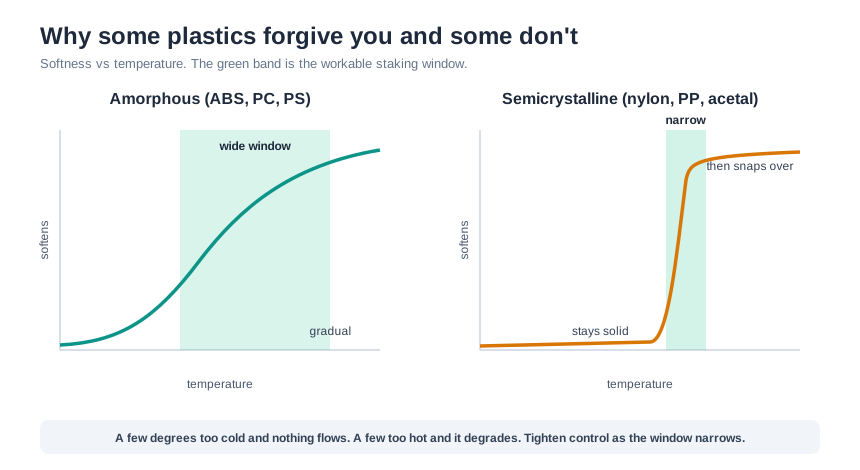
Amorphous plastics ease into softness. Semicrystalline ones stay stubborn, then let go all at once.
Amorphous plastics — ABS, PC, polystyrene — soften gradually. They go from firm to workable across a broad temperature range, so your window is wide and forgiving. You can be a few degrees off and still pull a clean head. These are the ones I hand to a new operator first.
Semicrystalline plastics — nylon, PP, acetal — stay solid, then snap over a sharp melt transition. A few degrees too cold and nothing flows. A few too hot and you're into degradation. The window is narrow, so your process control has to be tighter. This is where a press that just runs a timer starts losing parts.
My apprentice Jake once described nylon as "moody." He's not wrong, and I've stopped correcting him on the technical vocabulary because honestly "moody" is more useful than half the datasheets.
What too cold and too hot actually look like
You can read the temperature off the head if you know what you're looking at. Same press, same part, three settings:
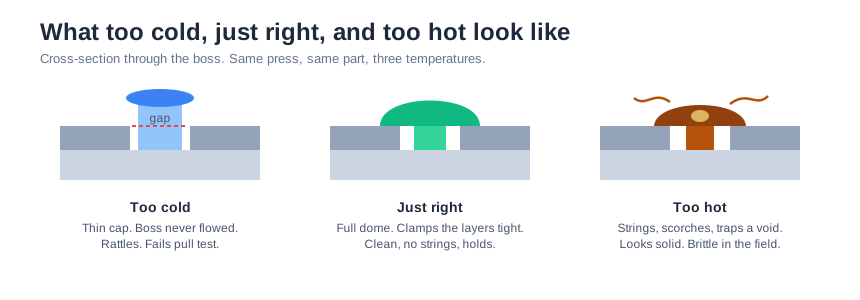
Cold leaves a thin cap that rattles. Hot strings and scorches and hides a void. The middle one is the whole job.
Too cold gives you a thin, pale cap that never fully formed. The boss didn't flow, so it doesn't spread, doesn't clamp, and the assembly rattles. It'll fail a pull test, and worse, some of them limp through inspection and fail in the field three months later.
Too hot is the showier failure. Strings on retract, a browned or scorched head, sometimes a hollow void hiding under a skin that looks fine from the top. It also passes inspection and fails later, which is the worst kind of failure — the one that waits.
Just right is a full, clean dome that spreads wide and pulls the layers tight. No strings. No scorch. It's almost boring to look at, which is exactly how a good joint should be.
Temperature is one of three dials
Temperature gets all the attention, but it doesn't work alone. Heat staking parameters come as a set: temperature, pressure, and dwell. Trade one against another and you can land in the window from a couple of directions.
Run a touch cooler and you'll need more dwell to move the same heat. Run hotter and you can shorten dwell, right up until you're scorching. Heat staking pressure does its real work after the melt — you cool the head under pressure so it solidifies in the shape you formed, instead of relaxing back. Skip the cool-under-pressure step to shave a second and you'll trade it back in cracks later.
There's a fourth quiet variable people forget: how you deliver the heat in the first place. Hot air versus a heated tip changes how the boss sees temperature, and it changes whether you string. And if you want the whole sequence in order, the full heat staking process, step by step walks the heat-cool-retract cycle.
Real Example: Why 320 °C Scorched Polycarbonate
A customer once called certain they had a broken machine. Heads coming out brown and brittle, the plastic faintly smoking, scrap piling up. They'd tried everything except the one thing.
I asked one question: what temperature are you running? Three-twenty. On polycarbonate.
PC stakes around 280 and starts to string and burn well above that. They'd inherited the recipe from an old ABS job and never changed it for the new material — same press, same fixture, completely different plastic, identical setpoint. We dropped the tip forty degrees and the problem was gone in a single shot. No new machine. No service visit. Just a number that belonged to a different resin.
Nine times out of ten, "the machine is broken" is "the recipe is wrong." Check the recipe before you pick up the phone — and if you do pick up the phone, that's fine too, because that's what we're here for.
Why There's No Single Heat Staking Temperature
Here's the strong opinion I'll stand behind: temperature is set by the polymer, not the press, and anyone quoting you a single "we stake everything at X" number doesn't understand the job. A heat staking temperature chart is a starting point, not a setting. The real target is energy into the boss — enough to flow it, not so much you cook it — and that target moves with every material, boss size, and ambient condition.
That's the thinking behind our patent-pending "Weld by Energy" control. Instead of hand-timing a dwell and hoping the dial holds, each cycle delivers the precise energy needed to form that boss, then the tip cools under compressed air so the head solidifies with no sticking and no stringing on retract. A 0.1 mm linear encoder confirms the boss is even there before the cycle runs and that the head finishes within tolerance. It's the difference between controlling the outcome and chasing it. (For the record, "Weld by Energy" was the marketing team's name, not mine. Mine was "the good one." They went a different direction.)
It works across ABS, polycarbonate, nylon, polypropylene and the other usual thermoplastics — and if your joint shouldn't be staked at all, we'll tell you that too, which is a sentence most equipment vendors physically cannot say.
If you've got a part fighting you, send it over. We'll dial in the window, pull-test it, and turn around a quote within 24 hours of a free evaluation — give us a call and we'll sort the joint. For broader material behavior, the folks at Assembly Magazine have a solid overview of the staking process worth a read too.
Get the temperature matched to the plastic and cool it under pressure, and your joint will outlast the product, the warranty, and possibly the engineer who picked the resin.
FAQ — Straight answers
What temperature do you heat stake at? There isn't one number. The right temperature is set by the polymer, not the press. As rough heated-tip starting points: ABS ~200-230 C, polycarbonate ~260-300 C, nylon ~240-280 C, polypropylene ~180-230 C, acetal ~180-210 C. Always validate against your own grade with a pull test.
What temperature does ABS heat stake at? ABS usually forms a clean head with a tip around 200-230 C. It's amorphous, so it softens over a wide band and forgives a few degrees either way. That wide window is why ABS is one of the easiest plastics to stake.
Can you heat stake nylon, and does it need drying? Yes, but dry it first. Nylon absorbs moisture, and that moisture flashes to steam in the molten head, leaving bubbles and a weak, porous stake. Dry the parts and the bubbling disappears.
Why is my heat stake stringing or scorching? Almost always too hot. Above the plastic's window the resin degrades, pulls strings on retract, and browns. Drop the temperature in small steps until the strings stop and the head comes up clean.
Why won't my stake form a head, or why is the joint loose? Usually too cold, or the boss geometry is wrong. Below the window the plastic never really flows, so you get a thin cap that doesn't clamp. Check temperature first, then confirm the boss has enough material and a fillet at the base.
Does glass-filled plastic change the staking temperature? It changes the result more than the setpoint. Glass fibers don't melt, so they leave a rough, matte head even at the right temperature. Expect a fuzzier head, often a little more heat and dwell, and switch to a hollow or flared head style if appearance matters.
Is the heat staking temperature the same as the plastic's melting point? No. The tip runs hot to move heat into the boss quickly over a short contact time, so tip temperature isn't the resin's melt point. What matters is getting the plastic itself into its softening window, then cooling it under pressure.